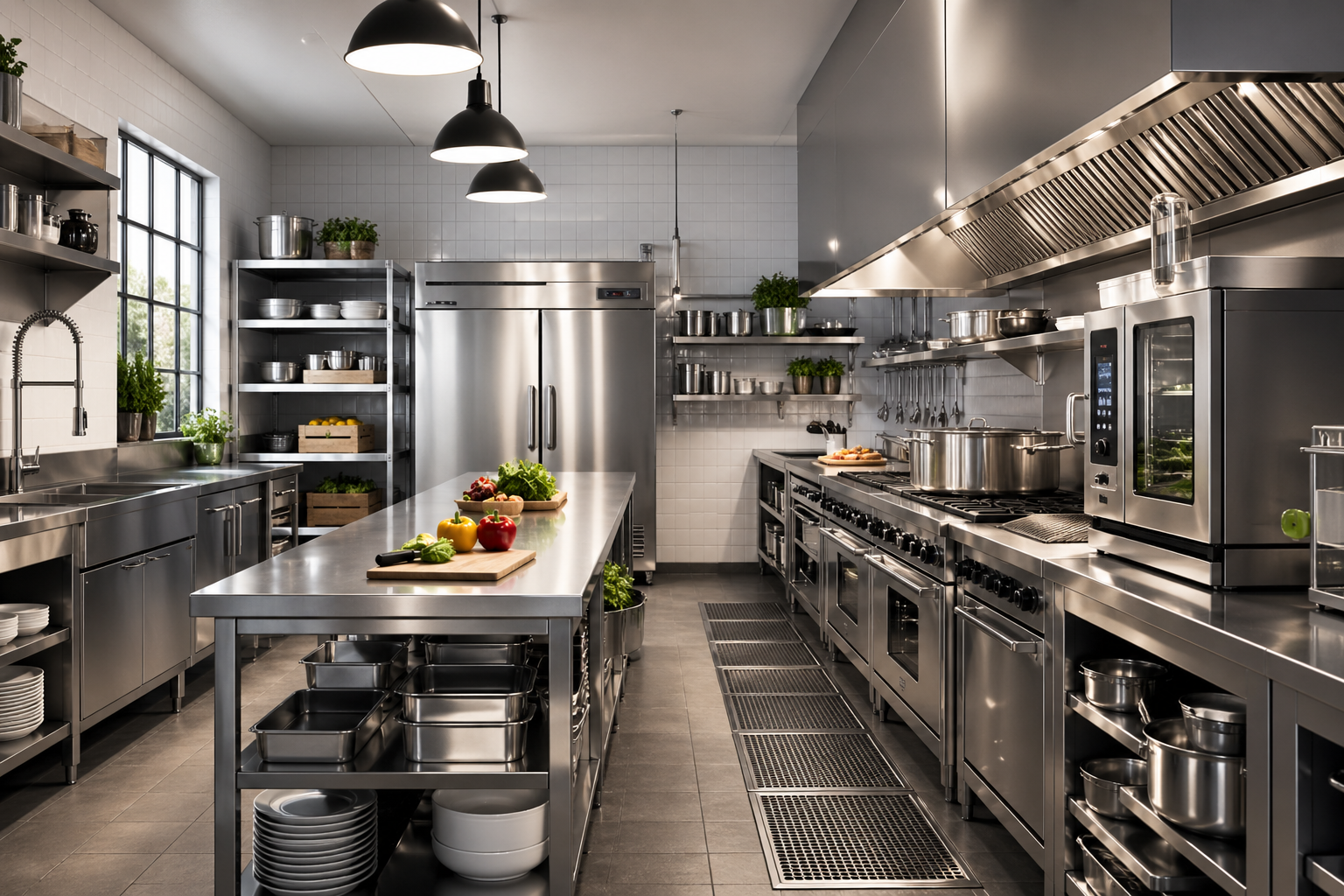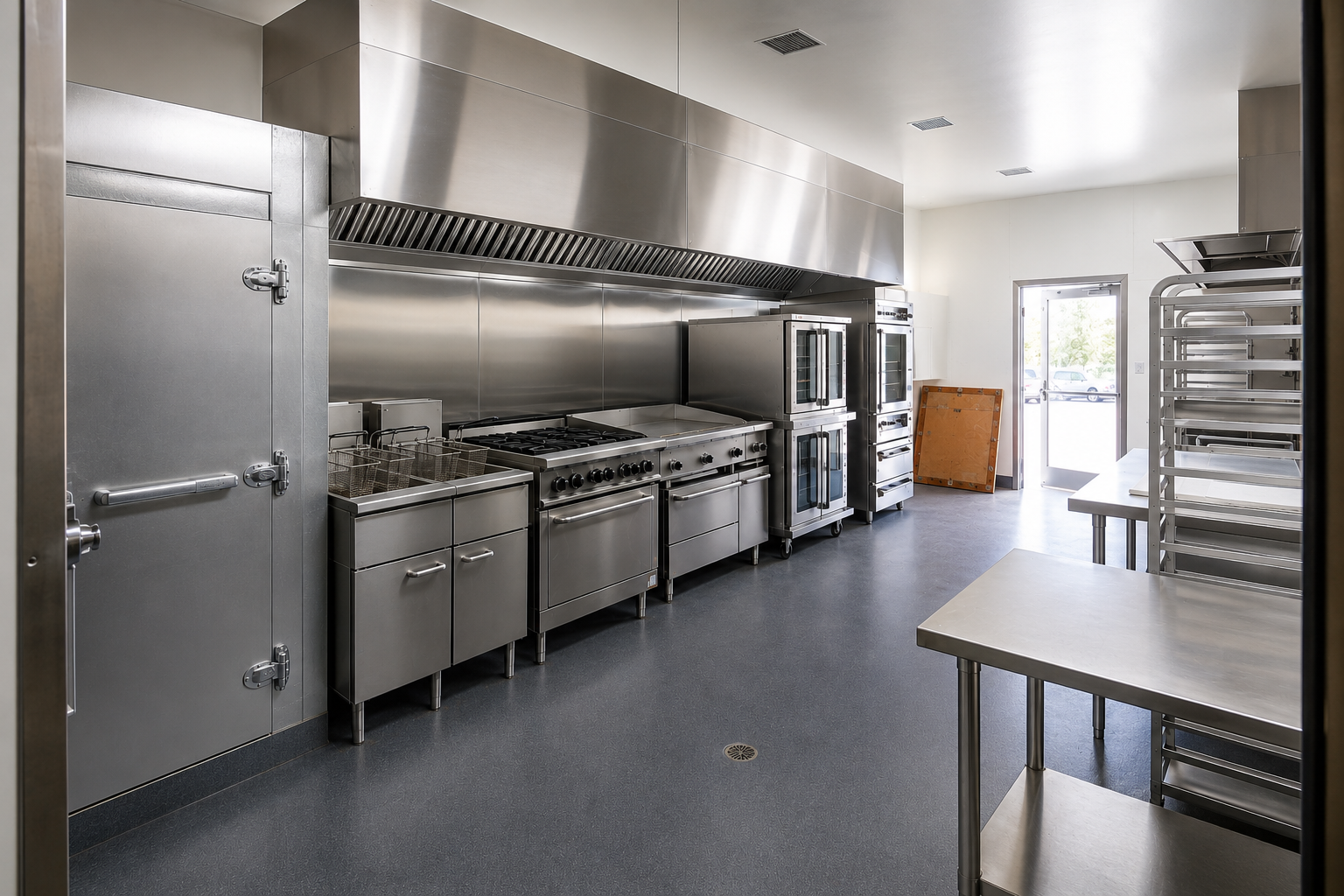
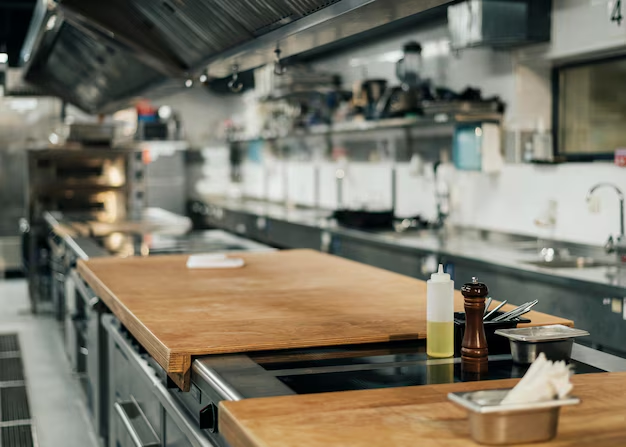
What Equipment Is Required in a Commercial Kitchen?
Most people think setting up a commercial kitchen is mostly about buying a range and a fridge. Then the first real quote lands in their inbox.
Suddenly there are questions nobody warned you about. What do I actually need on day one? What can wait? Why does every supplier give me a slightly different answer?
Here is the honest version. There is no single list that fits every kitchen. A neighborhood taco spot and a hotel property live in different worlds. But both share a core set of equipment that separates a kitchen that holds together from one that falls apart on a busy Friday night.
This guide walks through every major category: cooking equipment, refrigeration units, food prep equipment, warewashing, ventilation, and more. By the end, you will know exactly what belongs in your kitchen and why.
Cooking Equipment: Where Your Menu Comes to Life
This is the category people obsess over and for good reason. Your cooking lineup determines what you can serve, how fast you can deliver it, and how hard your team works every shift. Everything else in your kitchen exists to support what happens here.
Commercial Ranges and Cooktops
The commercial range is the single most important piece of restaurant equipment in most kitchens. It combines a powerful cooktop with an oven beneath, letting your line cooks run multiple techniques without ever leaving their station.
Unlike residential stoves, commercial ranges are built to run 12 to 16 hours a day without skipping a beat.
The BTU output, the burner design, the oven capacity: all of it is calibrated for sustained, high-volume service.
The right configuration depends entirely on your menu. Open burners for sauce work and sautéing, a flat griddle section for breakfast and burgers, or a combination. Get this wrong and your kitchen works against you from day one.
Ovens
Your range oven does a lot of work. But if you’re running real volume, standalone ovens are where capacity lives.
Convection ovens are the workhorses of professional kitchens: fan-driven circulation means even heat across every rack, faster cook times, and the ability to run multiple trays simultaneously. For bakeries and pizza-forward concepts, deck ovens deliver the direct stone-contact heat that creates those crispy bases no convection unit can replicate.
For kitchens that want maximum versatility, combi ovens handle roasting, steaming, baking, and proofing in a single unit. Higher upfront cost, but for the right operation, they pay for themselves within a year.
Commercial Fryers
If anything fried is on your menu, a dedicated commercial floor model isn’t optional.
We’re talking high BTU output, a reliable thermostat, and a filtration system that actually extends oil life. Countertop fryers exist, but they’re built for secondary use. Floor models handle volume, maintain temperature during back-to-back drops, and come with multiple fry pots so you can cook proteins and sides at the same time without cross-contaminating flavors.
Griddles and Char-Broilers
A flat-top griddle is one of the most versatile investments you’ll make. Breakfast service, smash burgers, grilled vegetables, quesadillas, and a 36 or 48-inch flat top handles it all simultaneously. Pair it with a char-broiler for open-flame flavor that can’t be faked, and your line suddenly has a lot more range.
Steamers
Steamers are quietly one of the most efficient pieces on any commercial kitchen equipment list. Vegetables, seafood, rice, dim sum and all are cooked in minutes while preserving color and nutrients.
Boilerless models connect directly to a water line, which eliminates the need for a separate boiler and reduces the number of variables you’re managing during service. Worth the consideration.
Specialty Equipment
Beyond the core lineup, your concept dictates what else belongs in your kitchen. Salamanders for finishing and glazing. Tilting skillets for large-batch braising. High-BTU wok ranges for Asian-forward menus. Tandoor ovens, rotisseries, pasta cookers.
None of these are universal, but for the right kitchen, they’re every bit as essential as a range.
Refrigeration and Cold Storage: Your Food Safety Foundation
Cold storage is the unsexy part of a commercial kitchen setup. It’s also the most consequential. Without the right refrigeration in place, you can’t hold ingredients safely, can’t prep ahead of service, and won’t pass a health inspection. Everything else depends on this working correctly.
Reach-In Refrigerators and Freezers
The everyday workhorses. One, two, and three-door configurations positioned throughout the kitchen, near prep stations, along the line, wherever your team needs quick access without crossing the floor.
Look for self-closing doors and digital temperature displays. These aren’t luxury features; they’re the difference between temperature logs that work and ones that become a liability during an inspection.
Walk-In Coolers and Freezers
Once your delivery volumes get serious, walk-ins become non-negotiable. Your walk-in cooler holds proteins, dairy, produce, and prepped items. Your walk-in freezer holds frozen inventory.
Size them based on delivery frequency: the less often your deliveries come in, the more cold storage you need on hand. One of the most common and expensive mistakes in any commercial kitchen setup is undersizing the walk-in to save money upfront. That decision costs you in operational stress and storage capacity for years.
Refrigerated Prep Tables
These combine a stainless steel work surface with cold storage directly underneath. On a pizza station, a sandwich line, or a salad bar, this means ingredients stay within arm’s reach at safe temperatures throughout service. No unnecessary movement, no temperature excursions, smoother execution.
Ice Machines
Ice machines are consistently underestimated during the planning phase; the regret tends to hit during your first heat wave. Ice is critical for beverage service, ingredient cooling, and food presentation.
Plan for peak demand plus a 20% buffer. You will always use more ice than you expect, especially in summer. Modular units with separate bins give you the most flexibility as your volume grows.
Food Preparation Equipment: Where Labor Hours Are Won or Lost
Prep is where most kitchen labor hours actually go. The right equipment in this category doesn’t just make prep faster, it makes it more consistent. And consistent prep means better food quality, lower waste, and more predictable costs every single week.
Commercial Food Processors
If your team is hand-cutting meaningful volumes of vegetables or other ingredients during every prep shift, a commercial food processor will pay for itself within weeks. Slicing, dicing, shredding, pureeing, all done in minutes, with results that are more uniform than any amount of skilled knife work at that speed.
Stand Mixers
Essential for any baking program, and genuinely useful in almost every kitchen. Doughs, batters, whipped toppings, sauces, shredded proteins. A heavy-duty stand mixer handles the kind of volume that would take a cook an hour by hand.
Match capacity to your batch sizes: 20-quart for smaller operations, 40 to 60-quart for mid-size, 80-quart for production-level output.
Slicers
Consistent portioning is margin protection. A commercial meat slicer delivers uniform cuts of proteins, cheeses, and vegetables with less waste and better presentation than manual knife work, especially at volume.
Manual slicers work well at lower volumes. For operations that slice in bulk, automatic is the move.
Prep Tables and Cutting Boards
NSF-certified stainless steel prep tables are the standard for a reason. Durable, sanitary, easy to clean after a long service. Pair them with color-coded cutting boards to prevent cross-contamination:
-
- Red for raw meat
- Yellow for poultry
- Green for produce
- White for dairy and ready-to-eat items
This is what health inspectors expect to see. More importantly, it is what protects your guests.
Scales and Portioning Tools
Every plate that goes out inconsistently portioned is money you did not plan to spend. Digital portion scales, measuring containers, and portioning scoops turn guesswork into a system. When your team uses them consistently, your food cost percentage becomes predictable. And that means it becomes controllable.
Storage and Shelving: The Part Health Inspectors Look at Closely
Storage isn’t just an organization problem. It’s a compliance issue. Health inspectors treat it exactly that way.
Food stored on the floor, raw proteins stored above ready-to-eat items, unlabeled containers, cluttered dry storage. These are the violations that add up fast and that can close a kitchen. The right shelving system makes compliance almost automatic.
Types of Shelving You’ll Need
-
- Wire shelving:The standard for walk-ins and dry storage. Air circulates freely, it adjusts easily, and it’s straightforward to clean.
- Solid stainless shelving:Best for areas where small items would fall through wire gaps, or where you want a cleaner finished appearance.
- Dunnage racks:Low-profile platforms that keep bulk items off the floor and within the 6-inch clearance required by most health codes.
- Mobile shelving:On wheels, for kitchens that reconfigure between services or event formats.
Dry Storage Best Practices
-
- FIFO every time. First In, First Out. Older stock in front, newer stock behind.
- Label everything: contents and the date received or prepped.
- Keep storage areas clean, well-lit, and dry. Pest inspectors notice the same things health inspectors do.
- Chemicals and cleaning supplies must be stored completely separate from food. No exceptions.
Warewashing and Sanitation: The Section Most People Underestimate
Warewashing covers everything involved in cleaning and sanitizing your dishes, glassware, utensils, pots, and pans.
It’s one of the most scrutinized areas during a health inspection, and it is also one of the areas where operators most often try to cut corners. dishwashing equipment isn’t optional; it’s the backbone of your food safety program.
Choosing the Right Commercial Dishwasher
The type of dishwasher you need comes down to volume:
-
- Under-counter dishwashers:Compact and efficient for bars, cafes, and small kitchens. Around 20 to 30 racks per hour.
- Door-type / upright dishwashers:The most common choice for full-service setups. 40 to 80 racks per hour.
- Conveyor dishwashers:Built for hotels, banquet facilities, and high-volume cafeterias. 200+ racks per hour without slowing down.
Three-Compartment Sinks
Even with a commercial dishwasher, a three-compartment sink is required in virtually every health jurisdiction. Wash, rinse, sanitize in that order, in separate compartments, with the correct chemical concentrations in each. Health inspectors will check the solution strength. This can’t just be a box you tick.
Dedicated Handwashing Stations
Separate from everything else. Not a prep sink, not a dish sink, so keep a dedicated handwashing station, accessible at all times, clearly signed, stocked with soap and paper towels. Using it for any other purpose is a violation, and it’s one of the first things checked on every single inspection without exception.
Ventilation and Fire Safety: The Expensive Reality You Can’t Ignore
Commercial Kitchen Hoods
Every piece of cooking equipment that generates heat, smoke, steam, or grease-laden air needs to be under an appropriate hood. Type I hoods go over grease-producing equipment: ranges, fryers, and char-broilers. Type II hoods cover heat and moisture producers like dishwashers and steamers.
Getting the hood specification wrong isn’t just a compliance problem. It’s a working conditions problem. A kitchen with inadequate ventilation is uncomfortable, smells, and creates real safety risks for your team every single shift.
Fire Suppression Systems
Type I hoods are required to have integrated fire suppression systems, typically wet chemical systems that activate automatically if a fire breaks out. These must be professionally installed, tested, and re-certified on a regular schedule (usually every six months). This is not an area where shortcuts make sense.
Make-Up Air
Your exhaust system removes air from the kitchen. A make-up air unit brings fresh, conditioned air back in to replace it. Without adequate make-up air, your kitchen depressurizes, doors become difficult to open, and your HVAC system overcompensates. It compounds over time and becomes a genuine problem.
What to Budget for Ventilation
Ventilation is consistently one of the most expensive line items in any commercial kitchen setup. Hood fabrication, ductwork, rooftop exhaust fans, make-up air units, and fire suppression together can run anywhere from $15,000 to $50,000 or more, depending on kitchen size and complexity.
Smallwares and Hand Tools: The Everyday Essentials That Add Up
Smallwares are the tools your team reaches for constantly during every service. Each item is inexpensive individually. Together, they’re the difference between a kitchen that moves and one that’s always scrambling.
The Core Smallwares Checklist
-
- Chef knives, paring knives, bread knives, plus a quality sharpener or honing steel
- Tongs in quantity: plan for at least 3 to 4 pairs per station, more during high-volume service
- Spatulas: rubber for bowls and mixing, metal for griddles and skillets
- Ladles, slotted spoons, and serving utensils across multiple sizes
- Sheet pans and hotel pans in full, half, third, and quarter sizes
- Mixing bowls in a range of sizes
- Digital thermometers: instant-read and probe-style for different applications
- Measuring cups, spoons, and portion scoops
- Squeeze bottles, portion cups, and deli containers
- Can openers, peelers, zesters, and bench scrapers
Budgeting for Smallwares
Operators consistently underestimate this category. For a mid-size kitchen, plan on spending between $2,000 and $10,000 depending on menu complexity and team size.
And build in a replacement budget from the start. Knives dull, thermometers get dropped, tongs disappear. This happens in every kitchen, everywhere, all the time.
Safety and Compliance Equipment: The Non-Negotiables
A stocked first aid kit, a Class K fire extinguisher rated for grease fires, and clearly posted emergency procedures are baseline requirements in any commercial kitchen.
Some jurisdictions also require eye wash stations near chemical storage areas. These aren’t optional additions. They are the legal minimum.
Floor Safety
Slips and falls are among the most common commercial kitchen injuries, and most of them are preventable. Wet floor signs should be readily available and used proactively, not only when something spills.
Anti-fatigue mats at stations where cooks stand for long stretches reduce injury risk and the kind of fatigue-related errors that creep in toward the end of a long service.
HACCP and Temperature Monitoring
A HACCP (Hazard Analysis Critical Control Point) plan requires documented temperature monitoring at every critical control point: receiving, storage, cooking, holding, and cooling.
Digital thermometers, temperature logs, and holding equipment with built-in monitoring turn compliance from a constant mental burden into part of your team’s daily routine. Learn more about warewashing systems that support your food safety documentation.
Technology and Kitchen Management Systems
Technology has become a genuine operational advantage. It is not a nice-to-have for kitchens that like gadgets. The right systems make communication cleaner, reduce errors, and give you real-time visibility into what’s actually happening during service.
Kitchen Display Systems (KDS)
A KDS replaces the paper ticket rail with a digital screen that updates in real time as orders come in from the floor. Ticket times are tracked automatically, modifications are immediately visible, and the communication between front-of-house and kitchen becomes significantly more reliable. For any kitchen running real volume, this is one of the highest-impact changes you can make.
POS Systems
Your point-of-sale system touches everything: order flow, payments, inventory tracking, and sales reporting. While it’s technically a front-of-house tool, the kitchen feels every POS decision that gets made. Make sure your system integrates cleanly with your kitchen workflow before you commit.
Wireless Temperature Monitoring
Modern temperature monitoring systems run around the clock, tracking every refrigeration unit and holding cabinet in your kitchen and sending alerts to your phone the moment something drifts outside a safe range. The technology is now affordable enough that there’s no good reason not to have it. One spoilage event will cost more than the entire system.
Frequently Asked Questions
What equipment is legally required in a commercial kitchen?
Health codes across most jurisdictions require, at minimum, a three-compartment sink, dedicated handwashing stations, proper refrigeration, cooking equipment under ventilated hoods with fire suppression, and adequate food storage shelving. Requirements vary by location, so always verify with your local health department before finalizing your setup.
How much does it cost to fully equip a commercial kitchen?
Costs range from around $30,000 for a small food truck or commissary up to $500,000 or more for a large full-service restaurant. The biggest cost drivers are ventilation, walk-in refrigeration, and primary cooking equipment. A phased approach, starting with the essentials and adding specialty items as your business grows, makes the investment far more manageable.
What’s the difference between commercial and residential kitchen equipment?
Commercial equipment is engineered for continuous high-output use under strict sanitation standards. It uses heavier materials, more powerful heating elements, and must meet NSF, AGA, and UL commercial certifications. Residential equipment breaks down quickly under real kitchen conditions and will not pass a health inspection.
Can I use residential equipment in a commercial kitchen?
Almost never. Health departments require NSF-certified or equivalent commercial-grade equipment. Using residential gear puts you at risk of failed inspections, fines, and insurance complications. Even for small or low-risk operations, always confirm with your local health authority before assuming residential equipment will be acceptable.
How do I know what size equipment I need?
Always size for peak demand, not average demand. Calculate your maximum meals per hour during your busiest service, then choose equipment that can handle that volume with a 10 to 20 percent buffer. Undersized equipment creates bottlenecks. Oversized equipment wastes energy and capital. Neither is a good situation.
Where can I get help planning my commercial kitchen?
The right equipment supplier does more than take your order. For warewashing specifically, our team,for any size operation, from a first-time concept to a multi-unit expansion.
Your Next Step: Plan, Budget, Build
Figuring out what equipment is required in a commercial kitchen is the starting point, not the finish line. The real work is matching the right equipment to your actual menu, your actual volume, and your actual space.
The choices you make now will shape how your kitchen runs for years. A smart commercial kitchen equipment list, built around a realistic setup, is the foundation everything else sits on.
Ready to get specific? Get in touch today!