Restaurant Equipment Maintenance: A Preventive Guide to Fewer Breakdowns
Equipment rarely fails at a convenient time. The walk-in quits on a Friday afternoon. The fryer won’t hold temperature during the lunch push. The dish machine starts leaving film on glasses the night of a private event. Look back at almost any of those failures and you’ll find a warning sign that showed up days or weeks earlier. Nobody was assigned to notice it.
A preventive restaurant equipment maintenance program fixes that. It turns upkeep from a string of emergency calls into a routine: small daily habits for the crew, scheduled work for technicians, and a written plan for the day something breaks anyway. This guide walks through how to build that program step by step, whether you run one kitchen or you’re opening your fortieth location.
Our service team fields the calls when equipment goes down, and the kitchens that call us least in a panic usually have a written process. That matters more than how new their equipment is.
Why Does Preventive Maintenance Beat Waiting for a Breakdown?
Reactive maintenance feels cheaper because nothing gets spent until something fails. Then the bill arrives all at once: an emergency service call, rush shipping on a part, product thrown out of a warm cooler, and a station that can’t run until the repair is done.
Preventive work spreads that cost into small, predictable pieces. Clean condenser coils keep a compressor from running hot. A worn door gasket replaced in March doesn’t become a spoiled walk-in in July. Grease cleared from the exhaust system on schedule never gets the chance to build into a fire hazard.
Step 1: How Do You Build an Equipment Inventory You Can Actually Use?
Every maintenance program starts with a list. Walk the kitchen and record every piece of equipment that plugs in, connects to gas, or holds temperature. For each one, capture:
- Make, model, and serial number, taken from the data plate rather than an old invoice
- Install date and the company that installed it
- Warranty start and end dates, including any separate parts or compressor coverage
- A digital copy of the manufacturer’s manual, which lists the maintenance the manufacturer expects
- The authorized service companies for that brand in your area
The serial number is the detail that gets skipped most often, and it’s the first thing a manufacturer asks for when you file a restaurant equipment warranty claim. For our customers, this is exactly the legwork our in-house team takes on.
If you run more than one location, keep the inventory in a shared spreadsheet or maintenance platform, not a binder in the back office. You’ll want to compare stores later.
Step 2: What Belongs on a Daily and Weekly Kitchen Equipment Maintenance Checklist?
Most preventive work is simple enough for trained staff to handle during opening and closing. A practical restaurant maintenance checklist looks something like this.
Daily tasks
- Check and log refrigerator and freezer temperatures at open and at close.
- Filter fryer oil and wipe down fryer exteriors and surrounding surfaces.
- Scrape griddles and charbroilers, then empty grease troughs and drip trays.
- Wash hood filters as often as your cooking volume requires. Busy fry and grill lines often need it every day.
- Drain and clean the dish machine, and check wash and final rinse temperatures against the data plate.
- Wipe reach-in door gaskets and look for tears, gaps, or frost buildup around the seal.
Weekly tasks
- Boil out fryers following the manufacturer’s instructions.
- Delime the dish machine and any steam equipment as often as your water hardness demands.
- Inspect the ice bin, chute, and scoop holder for slime or scale.
- Check gas hoses, restraint cables, and casters on any equipment that moves for cleaning.
- Look under refrigeration for standing water, which usually points to a clogged condensate drain.
Put the checklist where the work happens. A laminated sheet on the side of the walk-in gets used. A PDF on a manager’s laptop does not.
Step 3: Which Tasks Need a Monthly, Quarterly, or Annual Schedule?
The bigger jobs take more time, special tools, or a licensed technician. These are the tasks that slip most in commercial kitchen maintenance, because nobody feels them until something fails.
Refrigeration
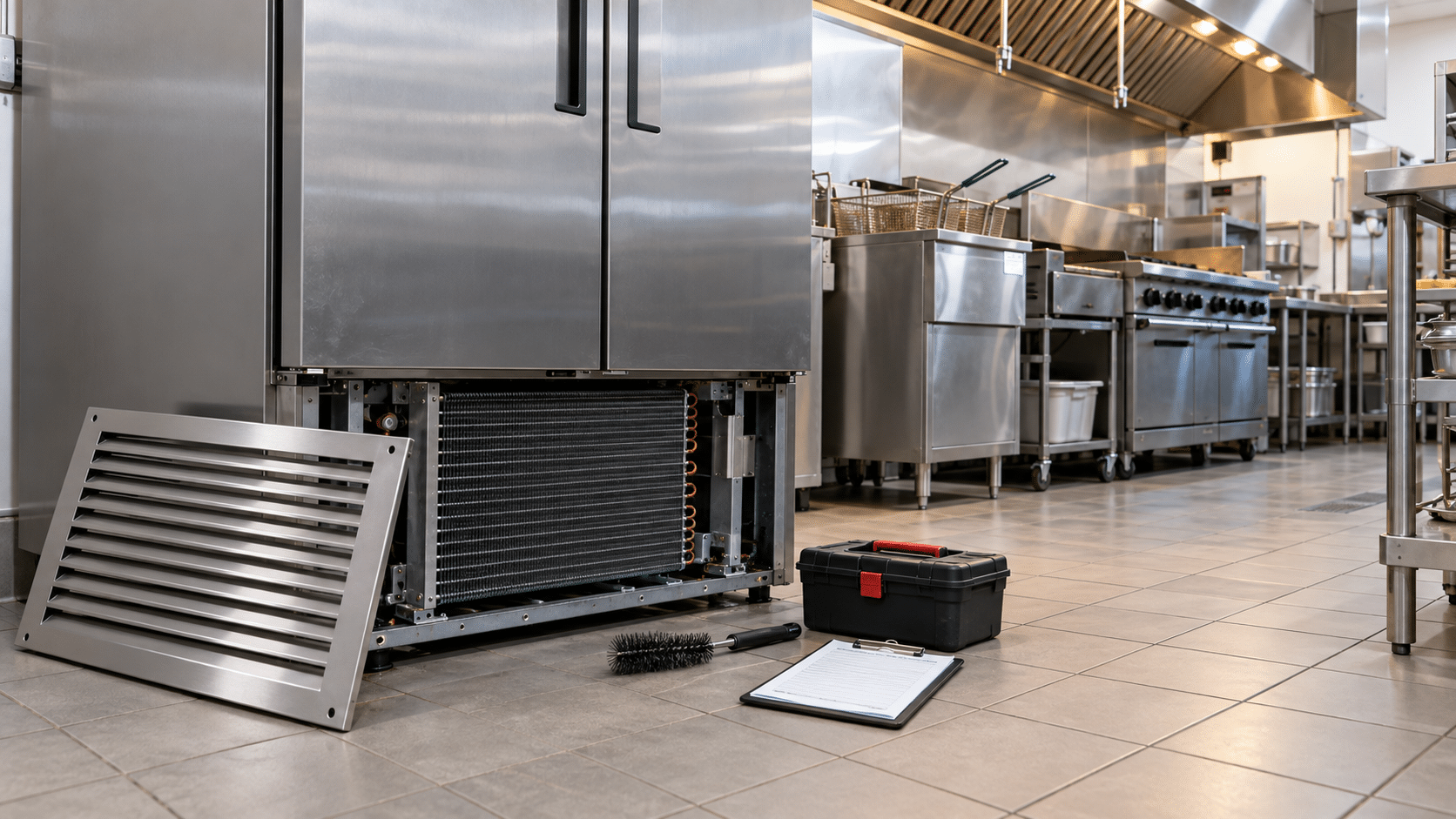
Condenser coils pull in the same greasy, flour-dusted air as the rest of the kitchen. When they clog, the compressor works harder and runs hotter. Commercial refrigeration maintenance should include coil cleaning on the interval in the manual, and more often for units that sit near fryers or the dish area. A technician visit should also cover refrigerant charge, fan motors, and defrost settings.
Ice machines
Ice is treated as food under health codes, so the machine’s water system needs periodic cleaning and sanitizing, not only the bin. Manufacturers publish a minimum interval, and hard water shortens it. Water filters need replacing on their own schedule.
Hoods and fire suppression
Kitchen exhaust systems fall under NFPA 96, the national standard for ventilation and fire protection in commercial cooking.
It ties inspection frequency to what and how much you cook: monthly for solid fuel such as wood or charcoal, quarterly for high-volume operations like 24-hour kitchens, charbroiling, or wok cooking, semiannually for moderate volume, and annually for low volume.
When an inspection finds grease buildup, the system gets cleaned. Fire suppression systems over the line need their own inspection at least every six months.
Your local fire marshal enforces the edition your jurisdiction adopted, so confirm your schedule with them.
Cooking equipment and gas
At least once a year, have a technician calibrate thermostats on ovens, fryers, and griddles, check ignition systems, and inspect gas connections. A fryer running a few degrees off turns out greasier food and burns through oil faster, and nobody on the line will notice the drift from one day to the next.
Warewashing
Your chemical supplier or service company should check dispensing rates, wash arms, and rinse nozzles on a set schedule. Scale and clogged nozzles are why most dish machines stop cleaning well long before they stop running.
Book quarterly and annual service during your slowest week of the season, and bundle as much as you can into one visit. One planned morning of downtime is far easier to absorb than three surprise afternoons.
Step 4: Who Owns Each Maintenance Task?
A checklist with no name on it is a suggestion. Assign every recurring task to a role rather than a person, so the system survives turnover. The opening cook logs temperatures. The closing dishwasher drains and cleans the machine. The kitchen manager signs off on the weekly list and books outside service.
Then keep a record. For each task, the log should show the date, who did it, and anything unusual they noticed. When a technician comes out, file the service ticket under that unit in your inventory. After a year, the record tells you which units are costing you money and which ones just run.
For multi-unit brands, the log is also how you spot patterns. If the same fryer model fails at six stores, you have a specification problem, and it belongs in the conversation before store seven opens.
Step 5: What Should Happen When Equipment Breaks Anyway?
Even a well-run program won’t prevent every failure. What it can do is make the response fast and calm. Write the escalation path down before you need it:
- Staff run the basic checks listed in the manual: power, breakers, gas valves, water supply, and any reset switch.
- The manager moves product to working storage or adjusts the menu to protect food and service.
- Someone photographs the data plate and writes a short description of the problem.
- That information goes to one contact who confirms warranty status and gets the right technician scheduled.
That last step is where most kitchens lose hours. Calling around for an authorized servicer, arguing over coverage, and chasing parts is time a manager should spend running the shift. Our service team handles all of it for FKG customers. They pull serial numbers, schedule repairs, expedite when needed, work to get warranty coverage approved, and keep you updated until the job is done. You reach them by direct line, never a phone tree.
When a unit can’t be saved, you shouldn’t have to wait months for its replacement. We keep inventory in more than 160,000 square feet of warehouse space, which all but eliminates the long lead times that come with ordering straight from a manufacturer.
How Does Maintenance Fit Into Your Wider Equipment Program?
Restaurant equipment maintenance starts earlier than most operators think. It starts when you choose the equipment. Standardizing models across locations means one parts list, one set of training, and one maintenance schedule for every store. Our guide on what equipment is required in a commercial kitchen is a good place to start that list.
Installation matters just as much. Equipment set without proper clearances or leveling fails early. Our network of certified installers handles turnkey installation in all 50 states, and our step-by-step installation guide covers what a proper install should include.
If you’re planning next year’s equipment budget, treat maintenance as its own line next to new purchases. The two decisions shape each other, a point we make in our kitchen equipment lessons for growing restaurant brands.
Frequently Asked Questions
What is the difference between preventive and reactive maintenance?
Preventive maintenance is scheduled work done before anything fails, such as cleaning coils, calibrating thermostats, and replacing worn gaskets. Reactive maintenance means waiting until equipment stops working and then paying to fix it. The more of your spending that shifts toward preventive work, the fewer emergency calls you’ll make.
Can kitchen staff handle preventive maintenance, or do you need a technician?
Staff can handle the daily and weekly work: cleaning, temperature logs, filter changes, and visual checks. Anything involving refrigerant, gas lines, electrical components, or fire suppression should go to a qualified technician. Opening those systems without training is unsafe and can put your warranty at risk.
Does skipping maintenance void an equipment warranty?
It can. Many manufacturer warranties exclude failures caused by neglect or improper care, and a compressor that burns out behind a clogged condenser coil is a common example. Read the warranty terms for each major unit when you add it to your inventory, and keep your maintenance log as proof of care.
Does preventive maintenance lower energy costs?
In most kitchens, yes. Dirty coils, torn gaskets, and doors that don’t seal force refrigeration to run longer to hold temperature. Cooking equipment that has drifted out of calibration wastes both energy and product.
How do multi-unit brands keep maintenance consistent across locations?
Standardize the equipment models, the checklists, and the way work gets logged. When every store runs the same units on the same schedule, regional managers can compare locations side by side and catch a problem at one store before it spreads to the rest. Working with a single equipment and service partner who knows your package makes that much easier.
When does it make sense to replace equipment instead of repairing it?
Look at the repair history, not just today’s bill. If a unit keeps failing, if parts are getting hard to find, or if repairs are approaching the price of a new model, replacement is usually the smarter move. It also makes sense when a newer model would support a menu change or match the equipment at your other locations.
Keep Every Kitchen Running
A restaurant equipment maintenance program takes some effort to set up, but after the first month it mostly runs on habit.
When you need help with the parts that don’t, like sourcing a replacement unit or chasing down a warranty claim, contact our team and we’ll help keep every location cooking.